
Henquiry: “What should I feed my flock if I have a rooster?”
This question was submitted through Henquiries and first answered on the Roots, Roost & Rafter Facebook page. I’ve expanded on the answer here to explain not only what to feed a mixed flock, but what a laying hen’s body actually does with all that calcium.
What should I feed my mixed flock?
If you keep a rooster with your hens, you should not feed everyone layer feed.
Layer feed is made specifically for birds that are actively producing eggs. It usually contains around 3.5 to 4.5 percent calcium because creating an eggshell almost every day requires an enormous amount of it.
Roosters do not have that same calcium demand. Neither do pullets that have not started laying, hens taking a break from laying, or older hens that have retired from egg production. These birds still need calcium for their bones, muscles, nerves and other normal body functions, but they need much less than a laying hen does. A rooster’s complete feed should generally contain around 1 percent calcium or less, rather than the much higher amount built into layer feed.
Here in Nova Scotia, the most practical option for many mixed flocks is:
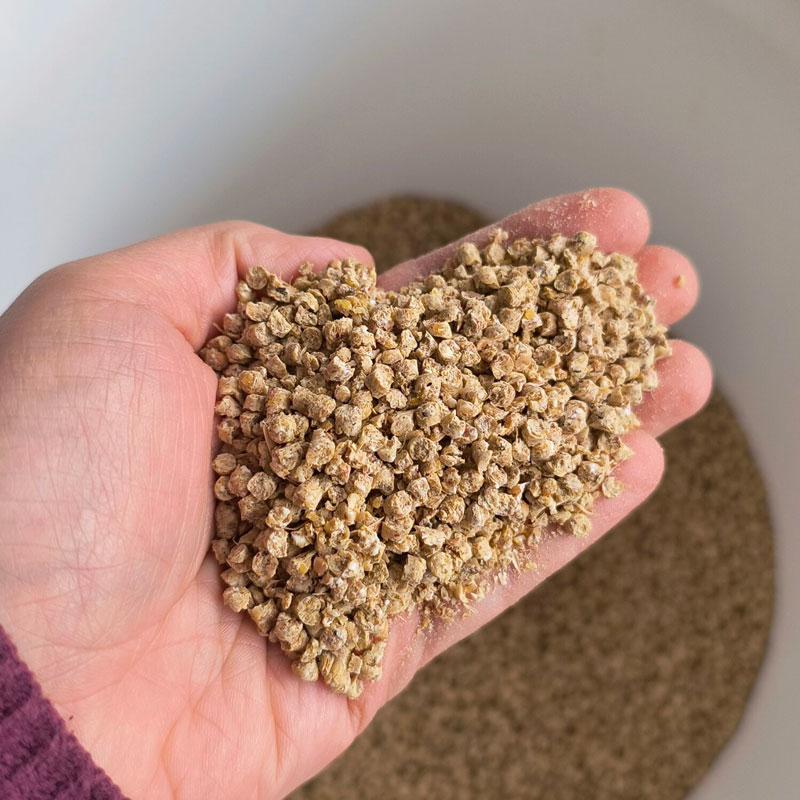
Feeding grower pellets or crumbles to all birds eight weeks of age and older.
Offering oyster shell separately for the hens that are laying.
An all-flock or flock-raiser feed is also a good option if you can find one. These feeds are designed for flocks containing birds with different calcium requirements, but they are not always readily available in our area.
Whatever feed you choose, check the label rather than relying only on the name on the bag. You want a nutritionally complete poultry feed appropriate for the ages and species in your flock, with calcium close to 1 percent rather than the 3.5 to 4.5 percent commonly found in layer rations.
Why not feed layer feed to everyone?
Calcium is not harmless simply because it is an essential nutrient. A bird’s body still has to process and remove what it does not need.
When a rooster eats layer feed, he cannot choose to leave the extra calcium behind in the feeder. It has been ground up and included in every pellet or crumble. Feeding that much calcium unnecessarily over the long term can place added strain on the kidneys and may contribute to kidney damage. If damaged kidneys can no longer remove uric acid effectively, chalky white urate crystals may accumulate around the internal organs (visceral gout) or in and around the joints (articular gout). Visceral gout can be fatal, while articular gout can cause painful swelling, stiffness and lameness.
A rooster accidentally eating a few pieces of oyster shell is not the concern. The concern is making him consume a high-calcium ration at every meal, every day, when his body has no egg production to use it for.
The same principle applies to chicks, growing pullets and birds that are not laying. Their nutritional needs are not identical to those of a hen producing eggs.
Will the rooster eat the oyster shell?
He might pick up the occasional piece, but most roosters will not consume oyster shell in the amounts that laying hens do. A rooster may investigate it, eat a little, or pick pieces up while tidbitting for his hens. A few pieces are not likely to hurt him.
Laying hens are much more motivated to seek out calcium when their bodies need it. Researchers call this a calcium-specific appetite. Hormonal and metabolic signals connected to egg production influence when and how much calcium a hen wants to consume.
It is a little like the unusual cravings sometimes associated with mineral deficiencies in people. The comparison is not exact, but the basic idea is similar: the body can influence food-seeking behavior when it needs a particular nutrient.
A rooster is not continually losing calcium into eggshells, so he usually does not have the same biological drive to stand at the oyster-shell dish and fill up on it. Non-laying hens and pullets also tend to consume less supplemental calcium than hens actively producing eggs.
This self-selection is useful, but it is not magical or perfect. Birds explore things with their beaks, individuals vary, and a rooster can still eat some oyster shell. The important difference is that separate oyster shell gives him a choice. Layer feed does not.
How does a hen put calcium into an eggshell?
A hen’s eggshell is made mostly from calcium carbonate. Producing one requires roughly two grams of calcium, which is a considerable amount for such a small animal.
The shell is added in the shell gland, also called the uterus, during the final stage of the egg’s journey through the oviduct. Shell formation takes many hours and much of the work happens overnight, while the hen is resting and not eating.
Calcium cannot travel directly from the oyster-shell dish to the egg. It must first dissolve in the digestive system, be absorbed through the intestine and enter the bloodstream. Her blood then carries calcium to the shell gland, where it is used to build the shell around the egg.
The hen’s body keeps the amount of calcium in her blood within a fairly narrow range because calcium is needed for much more than eggs. It is also involved in muscle contraction, nerve function and many other essential processes.
If calcium is being absorbed from her digestive tract while the shell is forming, the hen can use that dietary calcium. If there is not enough available, her body releases calcium from a special, temporary type of bone called medullary bone.
Medullary bone: The Hen’s Calcium Bank
Medullary bone forms inside some of a laying hen’s bones and acts as a readily accessible calcium reserve. Two types of bone cells help manage that reserve.
Osteoblasts take calcium and other minerals from the blood and deposit them as new medullary bone. When more calcium is needed for shell formation, osteoclasts break down that bone tissue, releasing the stored calcium back into the bloodstream so it can be carried to the shell gland.
This deposit-and-withdrawal process follows the hen’s reproductive cycle. Medullary bone is designed to be used and rebuilt, but it is not an unlimited supply. If her diet repeatedly fails to replace the calcium being withdrawn, her body may begin sacrificing structural bone as well. Over time, that can leave her with fragile bones while also affecting shell quality.
In plain language, her body prioritizes keeping calcium available in the blood and making the egg. If her food cannot supply enough calcium at the right time, her skeleton helps pay the bill.
Why is oyster shell offered in large pieces?
The size of the calcium particles matters. Finely ground calcium (like that in a layer pellet) moves through the digestive system relatively quickly. Larger pieces of oyster shell remain in the gizzard longer and dissolve gradually. This creates a slow release of calcium over several hours. There are benefits to offering oyster shell even if your flock consists of only laying hens who eat a layer feed.
It has been shown that hens are more likely to consume oyster shell in the evening before going to roost (and I’ve certainly witnessed my own hens regularly gobbling it up right before bedtime). That timing is particularly useful because the oyster shell sits in the gizzard overnight where it can keep releasing calcium into the bloodstream as the shell gland needs it. This reduces how much calcium must be taken from the hen’s bones.
Oyster shell is not the same as digestive grit
Although oyster shell is sometimes called soluble grit, it serves a different purpose from the insoluble grit chickens use to grind food.
Oyster shell gradually dissolves and supplies calcium. Insoluble grit consists of hard stone that remains in the gizzard and helps birds grind food. A flock may need both, depending on what the birds eat and whether they have access to suitable natural grit while foraging.
The SImple Answer
For a typical mixed flock containing a rooster and laying hens:
1) Feed everyone a complete grower or all-flock ration containing approximately 1 percent calcium.
2) Provide oyster shell separately and free-choice for the laying hens.
3) Do not mix the oyster shell into the feed.
4) Keep insoluble grit available separately if your birds eat foods other than commercial feed and cannot find appropriate grit while foraging.
5) Check the guaranteed analysis on the feed bag, since formulas and feeding directions vary between products.
This arrangement gives every bird an appropriate everyday ration while allowing the hens producing eggs to meet their much higher calcium requirements. The rooster may steal a piece of oyster shell occasionally, but he is no longer being served a layer-sized dose of calcium in every bite he eats.
Glossary:
Visceral Gout: A condition in which urate crystals accumulate on internal organs and other tissues, often appearing as a white, chalky coating. It occurs when the kidneys cannot adequately remove uric acid from the blood and is often associated with kidney damage or failure.
Articular Gout: A condition in which urate crystals accumulate in and around the joints. It can cause firm swellings, pain, stiffness and difficulty walking. Articular gout is less common than visceral gout in poultry and is usually a chronic condition.
Calcium-Specific Appetite: A biologically driven desire to seek out and consume calcium when the body’s need for it increases. It is particularly strong in laying hens during eggshell production.
Medullary Bone: A calcium-rich type of bone that forms inside certain bones of a laying hen. It acts as a readily available calcium reserve that can be used during eggshell formation.
Osteoblast: A bone-building cell. Osteoblasts take calcium and other minerals from the blood and use them to form new bone tissue, including medullary bone.
Osteoclast: A bone-resorbing cell. Osteoclasts break down bone tissue and release its stored calcium into the bloodstream when the body needs it.
Shell Gland: The section of a hen’s oviduct where the eggshell is formed. It is also called the uterus, although it does not serve exactly the same function as a mammalian uterus.
Oviduct: The reproductive tract through which a developing egg travels. Different sections add the egg white, membranes, shell and other finishing components.
Soluble Grit: A calcium source, such as oyster shell or limestone, that gradually dissolves in a bird’s digestive system. It supplies calcium but does not perform the food-grinding job of insoluble grit.
Insoluble Grit: Small, hard pieces of stone that do not readily dissolve. They remain in the gizzard and help grind food that a bird cannot break down with its beak.
Tidbitting: A food-related behaviour in which a rooster repeatedly picks up and drops an item while calling to attract hens to it.
Sources & Further Reading
Nutrient Requirements of Poultry, Medullary Bone and Avian Calcium Regulation, Exploiting Calcium-Specific Appetite in Poultry Nutrition, Merck Vet Manual: Urate Deposition (Gout) in Poultry, Science Direct: Laying hens prefer softer over harder mineral-based pecking stones and peck them more at the end of the light period